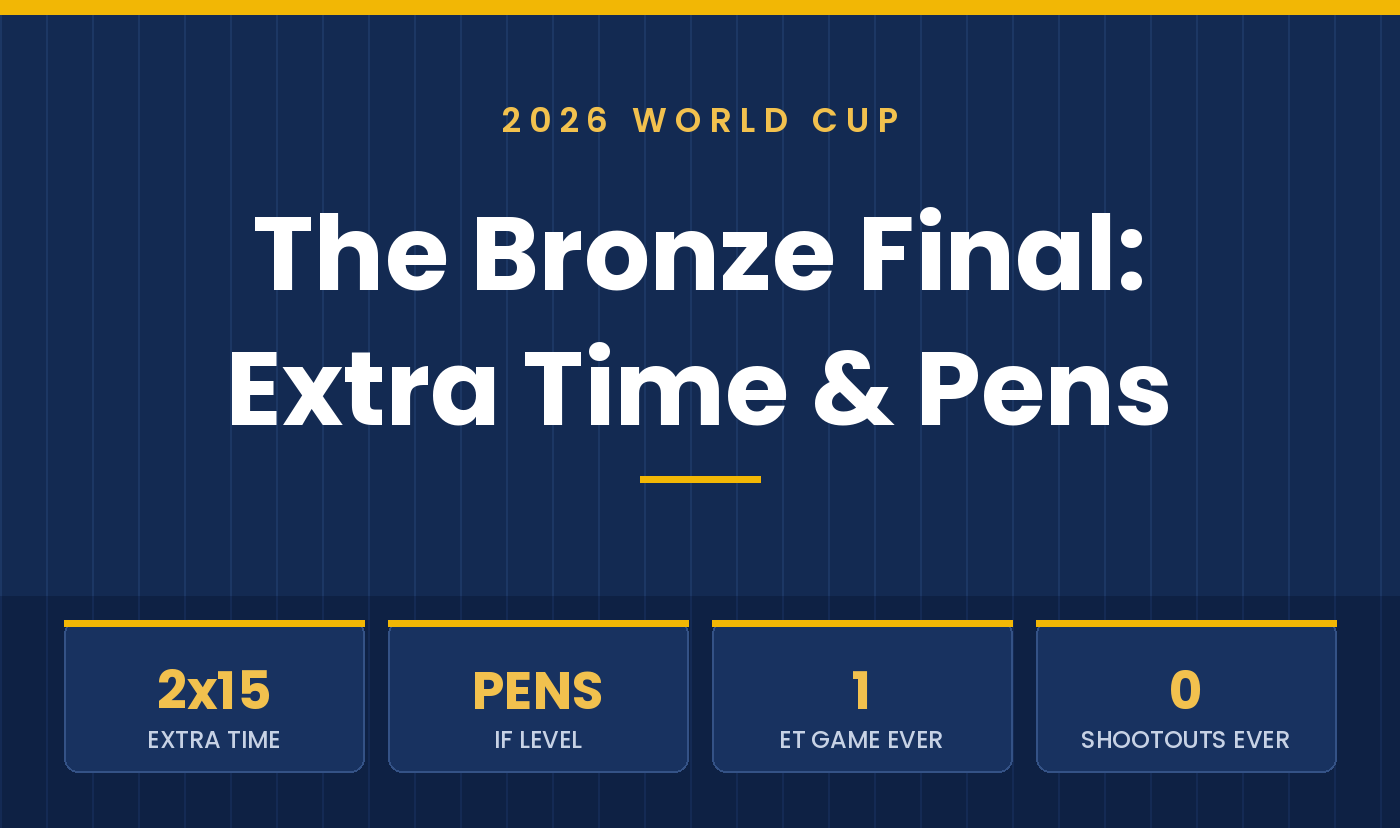
Yes — the World Cup third-place match can go to extra time and penalties. Under FIFA regulations, the bronze final follows exactly the same format as every other knockout match: if the score is level after 90 minutes, the teams play two 15-minute periods of extra time, and if it’s still tied after 120 minutes, a penalty shootout decides who finishes third. There are no replays and no exceptions.
The rule applies to the 2026 edition between France and England, played Saturday, July 18, at Hard Rock Stadium in Miami (5 p.m. ET, FOX), one day before the Spain-Argentina final. Both arrive from semifinal heartbreak — France beaten 2-0 by Spain, England surrendering a late lead in a 2-1 loss to Argentina — and the match doubles as Didier Deschamps’ farewell after 14 years in charge of Les Bleus.
Here’s the quirk of history, though: in nearly a century of World Cups, no third-place match has ever actually needed a shootout, and only one — France’s 4-2 win over Belgium in 1986 — has even reached extra time. Freed from the pressure of a final, semifinal losers tend to attack, which is why bronze finals are reliably among the highest-scoring games of any tournament. The full rules and history are charted below.
2026 World Cup
How FIFA settles a tied bronze final — and how rarely it’s needed
2×15Extra Time
PensIf Still Level
1ET Game Ever
0Shootouts Ever
The Rules If France-England Is Tied
FIFA knockout regulations for the 2026 World Cup.
| Situation |
What Happens |
Detail |
| Tied after 90 minutes |
Extra time |
Two 15-minute periods, with stoppage time added to each |
| Tied after 120 minutes |
Penalty shootout |
Best-of-five kicks, then sudden death |
| Replays |
None |
Every World Cup knockout match is decided in one game |
| Substitutions |
Five, plus a sixth |
Five in three windows; a sixth allowed in extra time; concussion subs are separate |
| Yellow cards |
Wiped after the quarterfinals |
A single booking carries no ban — Mbappé was carded vs. Spain but is free to play |
Third-Place Matches & Extra Time: The History
| Fact |
Answer |
Detail |
| Only bronze final to need extra time |
1986 |
France 4, Belgium 2 after extra time |
| Bronze finals decided on penalties |
Zero |
In nearly a century, no third-place match has reached a shootout |
| Why they stay open |
No tomorrow |
With nothing to protect, semifinal losers historically attack — bronze finals are famous for goals |
| First third-place match |
1934 |
Germany 3, Austria 2; every World Cup since has staged one |
New for 2026
If the match does go long, you’ll see the tournament’s new rules in action: a 10-second limit for substituted players to leave the pitch, an 8-second goalkeeper possession rule (corner conceded if broken), mandatory hydration breaks 22 minutes into each half, and expanded VAR.
The Golden Boot Subplot
Extra time could matter for the scoring race: Kylian Mbappé enters level with Lionel Messi at eight tournament goals, and every additional minute in Miami is a chance to pull ahead before Messi plays Sunday’s final.
Bronze Finals Deliver Goals
Recent editions: Croatia 2-1 Morocco (2022), Belgium 2-0 England (2018), Netherlands 3-0 Brazil (2014), Germany 3-2 Uruguay (2010). Defense-optional football is the tradition.
Why FIFA Keeps the Format
FIFA treats the bronze final as a full competitive fixture — it determines official third and fourth place, carries a $2 million prize-money difference, and awards bronze medals — so it gets full knockout rules rather than letting a tie stand. In practice, the open, attacking nature of the game means the rules almost never get stress-tested: 90 minutes has settled every bronze final since 1986.
The Bottom Line
The third-place match goes to extra time and then penalties if needed, same as any World Cup knockout game — but history says it won’t be: one extra-time bronze final ever, zero shootouts. For what’s actually at stake in Miami, see what the third-place winner receives.