
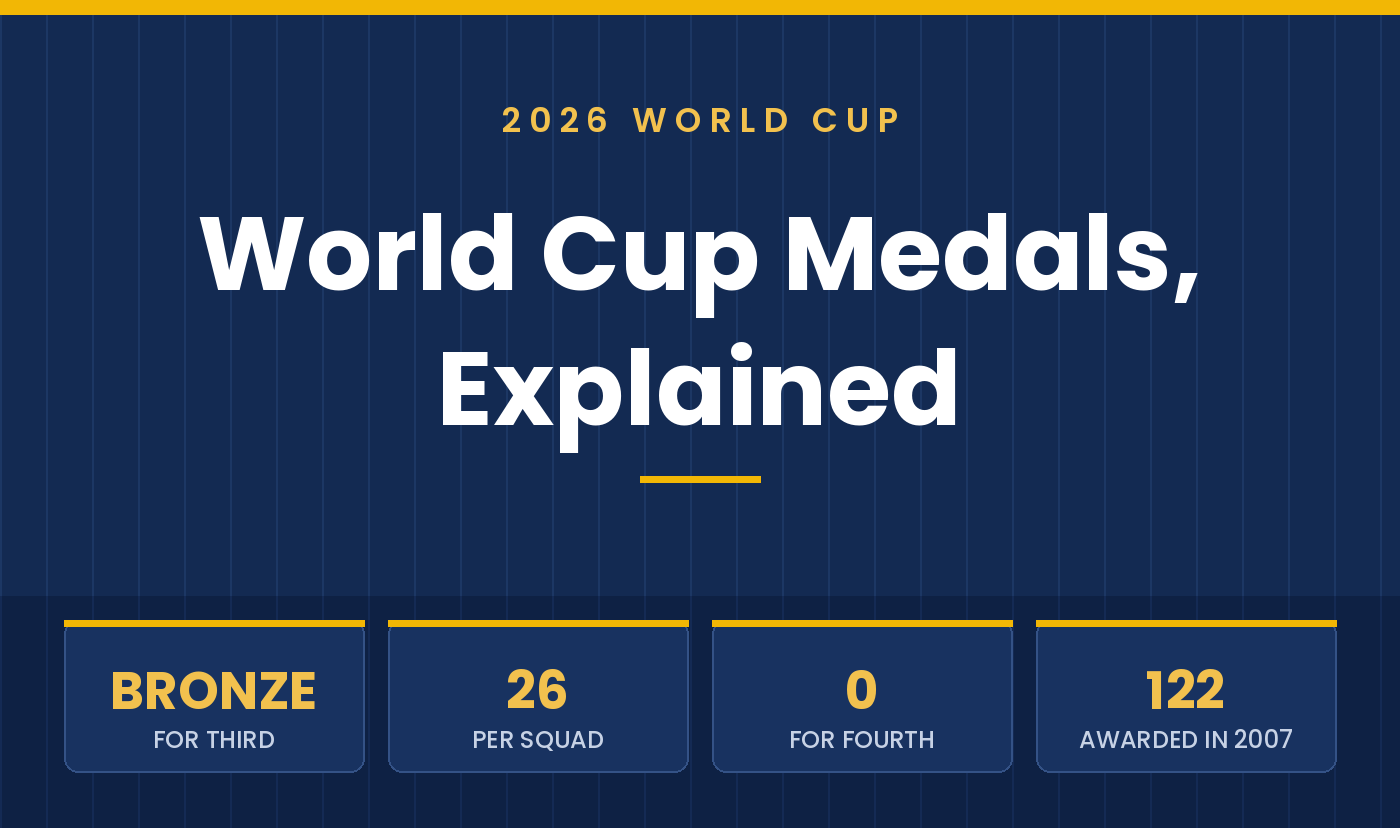

Yes — players receive bronze medals for finishing third at the World Cup. The winner of the third-place match gets medals for its entire 26-player squad and coaching staff, mirroring the gold and silver awarded to the champion and runner-up after the final. Fourth place receives nothing, which is precisely what separates Saturday’s France-England bronze final in Miami from a meaningless exhibition: one squad leaves with hardware, the other with a handshake.
Every member of the winning squad is medaled whether they played every minute or none at all — a modern courtesy that took FIFA decades to adopt. Before 1978, only the eleven players on the pitch at the end of the final received medals; squad players, and even match-winners substituted off, went home empty-handed. FIFA extended medals to full squads from 1978, and in 2007 it went back and retroactively awarded 122 medals to squad members from champion teams between 1930 and 1974 who had been snubbed by the old rule.
The bronze medal comes bundled with $29 million in prize money and an official podium finish. The full medal structure, and how it evolved, is below.
Does a Bronze Medal Actually Matter?
Ask Croatia. For smaller footballing nations, a World Cup bronze is a generational achievement displayed in federation museums and stitched into legacy — Belgium’s 2018 medal is the crown of its golden generation, and Turkey’s 2002 bronze remains its greatest football moment. For giants like France and England the medal reads differently, as consolation — but no player has ever refused one, and the podium classification follows every one of these squads into the record books permanently.
The Bottom Line
Third place at the World Cup earns real bronze medals for the full squad and staff; fourth place earns none. Add the $29 million prize and the podium finish, and the bronze final has genuine stakes — settled, if necessary, by extra time and penalties like any other knockout match.