
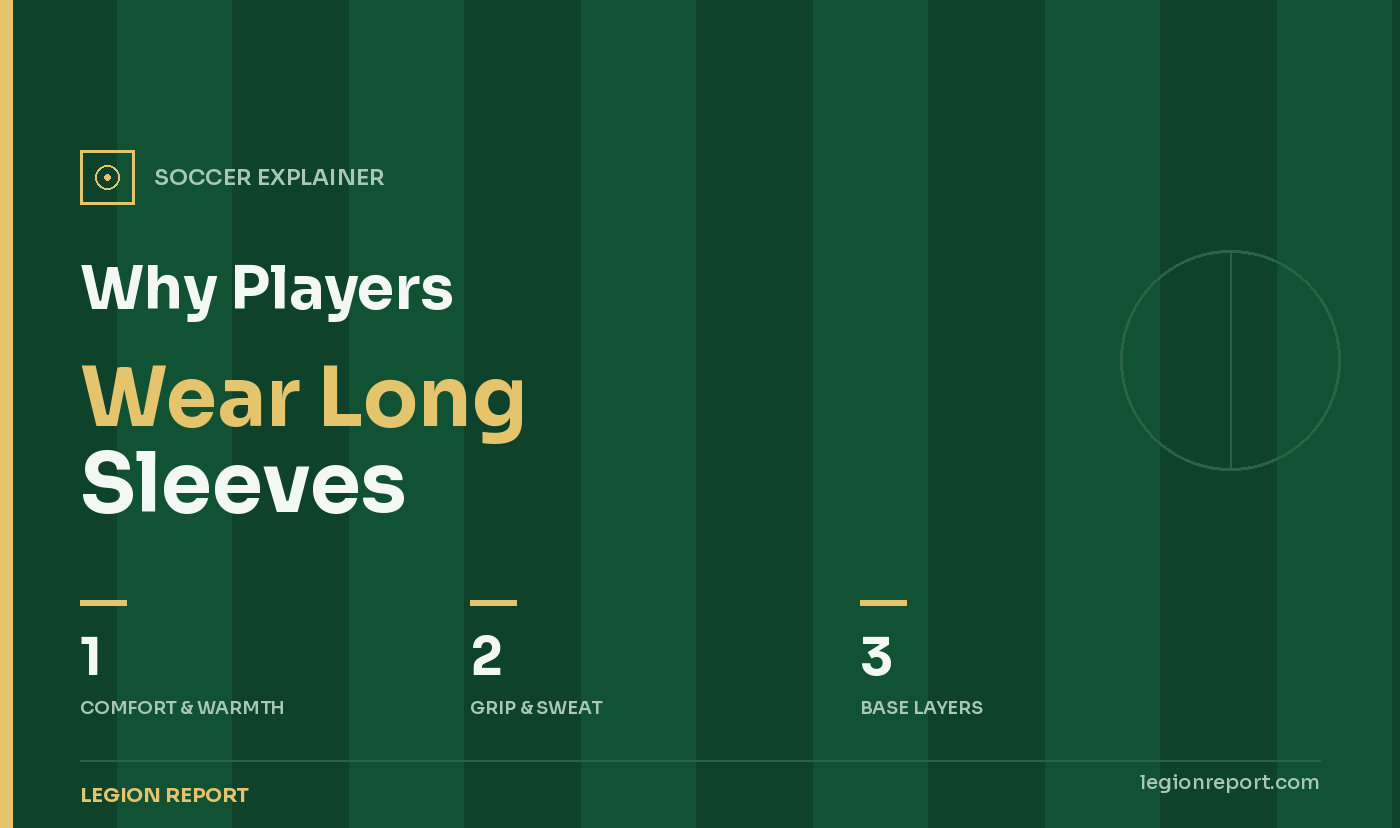

Watch any soccer match and you will notice that even on a warm day, some players wear long-sleeved shirts or have a base-layer undershirt poking out beneath their jersey, while their teammates wear short sleeves. It is one of those small details that puzzles many fans: if it is not cold, why cover up? The answer comes down to a mix of comfort, performance, and personal preference.
There is no single rule forcing the choice. Players are generally free to pick long or short sleeves, and to wear undershirts (within kit regulations), based on what feels best for them. The reasons range from warmth and muscle care to grip, sweat management, superstition, and the modern use of GPS-tracking base layers. Understanding them clears up a common soccer mystery.
The chart below breaks down the reasons players wear long sleeves and undershirts. Take a look, then we’ll go through the details.
Why players wear long sleeves
The most common reason players opt for long sleeves is warmth and comfort. In cooler weather, long sleeves help keep the body and, importantly, the muscles warm, which players believe helps them perform at their best and may reduce the risk of muscle strains and pulls. Warm muscles are more pliable, so many players prefer the extra coverage even in conditions that do not feel especially cold to spectators.
Beyond temperature, it often comes down to simple personal comfort and preference. Some players just feel more comfortable and confident in long sleeves and choose them regardless of the weather. Long sleeves can also offer a bit of protection against turf burns, scrapes, and grazes from sliding tackles or falls on the pitch. With no rule dictating sleeve length, the decision is generally left to each individual.
Why players wear undershirts
The undershirt, or base layer, worn beneath the main jersey serves several practical purposes. Modern base layers are typically made from moisture-wicking fabrics that draw sweat away from the skin, keeping players drier and more comfortable during a match. Many are also compression garments, which fit tightly to support the muscles and are believed by some to aid circulation and recovery.
An undershirt also acts as a comfortable buffer between the player’s skin and the main jersey, preventing chafing during 90 minutes of intense movement. Just like sleeve length, wearing an undershirt is largely a matter of personal preference and comfort, though kit regulations usually require the undershirt’s sleeves to match the main color of the jersey for a tidy, uniform appearance.
One of the most interesting reasons behind those tight vests is technology. If you have ever noticed a small bump or unit between a player’s shoulder blades, that is a GPS tracking device housed in a special base-layer vest. These wearable trackers have become standard equipment across elite professional soccer, quietly worn under the jersey during both training and matches.
The GPS units collect detailed performance data, including the total distance a player covers, their top speed and number of sprints, heart rate, and overall physical workload. Coaches and sports scientists use this data to monitor fitness, manage training loads, and spot signs of fatigue that could lead to injury. So while a base layer looks like simple kit, it is often a key part of a club’s high-tech approach to player conditioning.
Personal preference and superstition
Ultimately, much of the long-sleeve-versus-short-sleeve decision comes down to individual habit, and sometimes superstition. Some players are simply creatures of habit who always wear what feels right, while others develop superstitions, associating long sleeves with a run of good form, for instance, and sticking with them for luck. This is why you will often see two players on the same team, in the same conditions, making opposite choices.
A number of famous players have been strongly associated with always wearing long sleeves, making it part of their on-field identity. Because the laws of the game leave sleeve length and base layers up to the player (within kit rules), these personal preferences are free to flourish. There is rarely one single reason; it is usually a blend of comfort, practicality, performance, and personal habit.
Final Word
Soccer players wear long sleeves and undershirts for a combination of practical reasons: warmth and muscle care, comfort, sweat management, muscle support, and, in the case of those tight vests, to hold a GPS tracker that monitors their physical performance. On top of all that, personal preference and even superstition play a big role, which is why teammates often make different choices.
Far from being a random quirk, the sleeve and base-layer decision reflects a mix of comfort, modern sports science, and individual habit. For more on the gear and rules of the game, see our explainer on soccer positions explained.