

Every summer, the NBA offseason explodes into life with free agency, the frantic period when players change teams, franchises reshape their rosters overnight, and hundreds of millions of dollars are committed in a matter of hours. It is one of the most exciting and unpredictable times on the basketball calendar, but the rules behind it, the moratorium, the salary cap, the different types of free agents, can be genuinely confusing.
At its simplest, free agency is the window when players whose contracts have expired are free to negotiate and sign with any team (subject to certain rules). It opens with a negotiating period, runs through a “moratorium” week when deals are agreed but not yet official, and is governed by the salary cap and a web of exceptions that determine how much teams can actually spend. Understanding the framework makes the whole whirlwind far easier to follow.
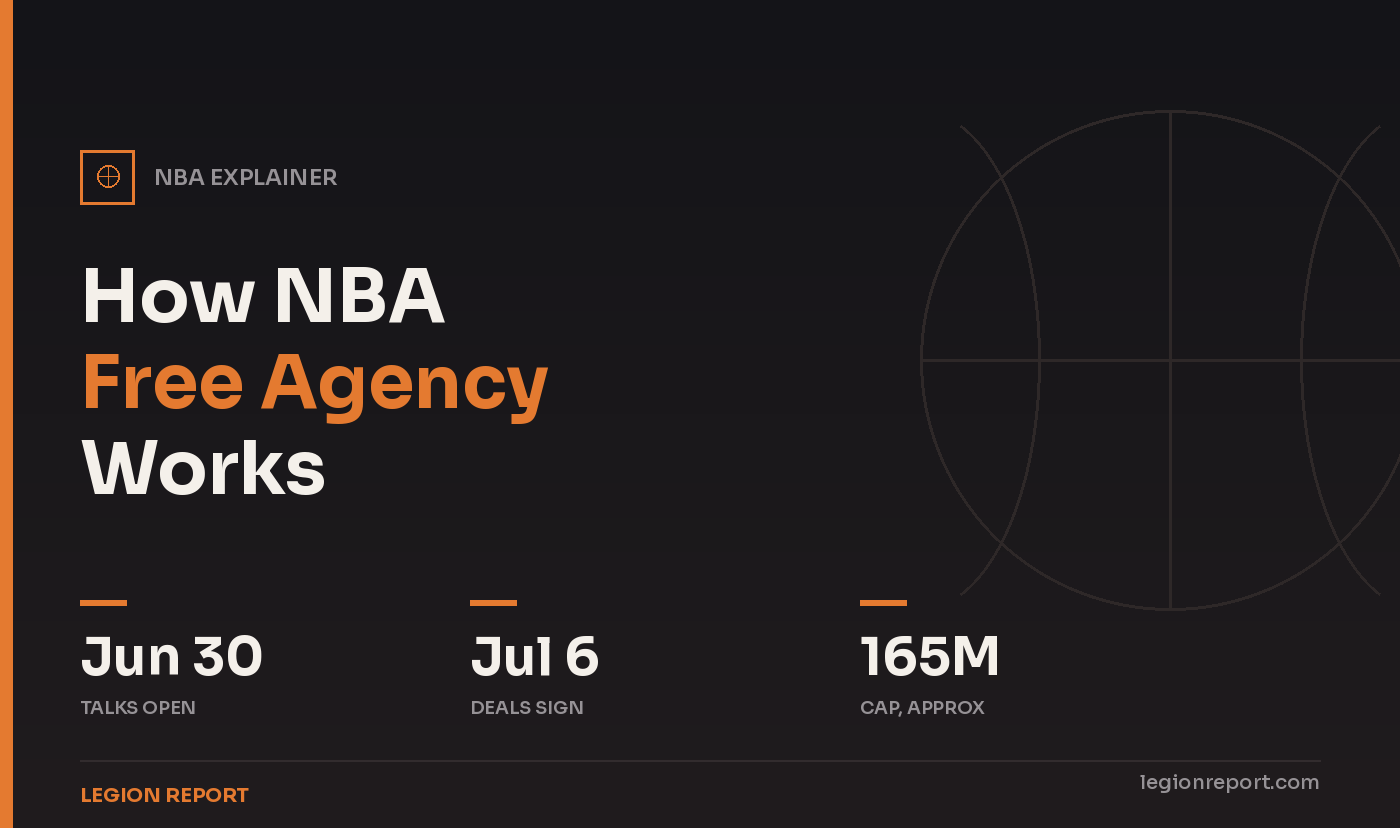
The chart below breaks down how NBA free agency works: the timeline, the types of free agents, the salary cap and exceptions, and the key terms. Take a look, then we’ll go through the details.
What NBA free agency is
NBA free agency is the period each offseason when players whose contracts have expired become “free agents,” meaning they are free to negotiate and sign a new contract. Depending on their status, that can be with any team in the league or, in some cases, with their old team holding a key advantage. It is the primary way, alongside trades and the draft, that teams add talent and reshape their rosters from one season to the next.
Free agency is so dramatic because of how much can change in a short window. Superstars can switch franchises, role players can land life-changing contracts, and a single signing can turn a struggling team into a contender. All of it plays out under the rules of the league’s Collective Bargaining Agreement (CBA), the deal between the league and the players’ union that governs the salary cap, contracts, and how players can move, so understanding the basic framework is essential to following the action.
The timeline: negotiating period and moratorium
Free agency follows a specific timeline. For the 2026 offseason, the negotiating period opens on June 30 at 6:00 p.m. ET, the moment teams can begin formally talking to free agents from across the league and agreeing to deals. This kicks off the flurry of reported agreements that dominate the news. Crucially, though, those early agreements are not yet official, they are verbal commitments only.
That is because of the “moratorium,” a period running roughly from July 1 through July 6. During the moratorium, the league finalizes its accounting from the previous season and sets the exact salary cap for the new league year (which begins July 1). Teams and players can agree to deals, but no contract can actually be signed until the moratorium ends, in 2026, at 12:01 p.m. ET on July 6. Until then, either side can technically back out of a verbal agreement, though that is rare.
The types of free agent
Not all free agents are equal, and the distinction is one of the most important concepts to grasp. An unrestricted free agent (UFA) is completely free to sign with any team for any amount the team can offer; his previous team has no special rights to keep him. These are the players who can move freely, and they drive the biggest headlines when they switch franchises.
A restricted free agent (RFA), by contrast, can negotiate with other teams, but his original team holds the “right of first refusal.” If the player signs an “offer sheet” with a rival team, his old team has a set window to “match” that offer and keep him on the same terms. A player typically becomes restricted when his team extends him a “qualifying offer,” which the player can also simply accept to play one more season before becoming unrestricted. This system lets teams retain their promising young players.
The salary cap and exceptions
All of this spending operates under the salary cap, the league-wide limit on how much each team can pay its players, set as a percentage of league revenue (around $165 million for the 2026-27 season). Critically, the NBA uses a “soft” cap, meaning teams are allowed to exceed it under certain circumstances, using tools called “exceptions.” This is why teams over the cap can still sign players.
The most important exceptions include Bird Rights, which let a team go over the cap to re-sign its own free agents (a huge advantage for retaining stars), and the mid-level exception, which lets an over-the-cap team sign an outside free agent for a set amount. Teams that spend well beyond the cap pay a penalty called the luxury tax, and under the current CBA, the biggest spenders face additional restrictions known as the “first apron” and “second apron,” which limit the moves they can make.
Other key mechanisms
A few other tools shape free agency. A “sign-and-trade” lets a player re-sign with his current team and then be immediately traded to a new one, often allowing the player to get a bigger contract and the original team to receive assets rather than losing him for nothing. Many contracts also include “player options” or “team options,” which give one side the choice to extend the deal by a year, a player declining his option is a common way stars reach free agency.
Finally, there is the “max contract”, the maximum salary a player can earn, which is tiered by experience. A player with 0 to 6 years of service can earn up to about 25% of the cap, rising to 30% for 7 to 9 years and 35% for 10-plus years, with an even higher “supermax” available to a select few who meet major award criteria with their own team. These rules are why you will hear a star is signing a “max deal”, it is a defined, capped figure rather than an open-ended number.
Final Word
NBA free agency is the offseason window when players with expired contracts can sign new deals, governed by a timeline that runs from the June 30 negotiating period through the early-July moratorium to the official signing date. Players are either unrestricted (free to go anywhere) or restricted (their old team can match offers), and all spending happens within the salary cap system and its many exceptions, from Bird Rights to the mid-level exception.
Once you understand the moratorium, the free-agent types, and how the soft cap and its exceptions work, the annual whirlwind of signings becomes far easier to follow. For a deeper look at the foundation of it all, see our explainer on what the NBA salary cap is and how it works.