
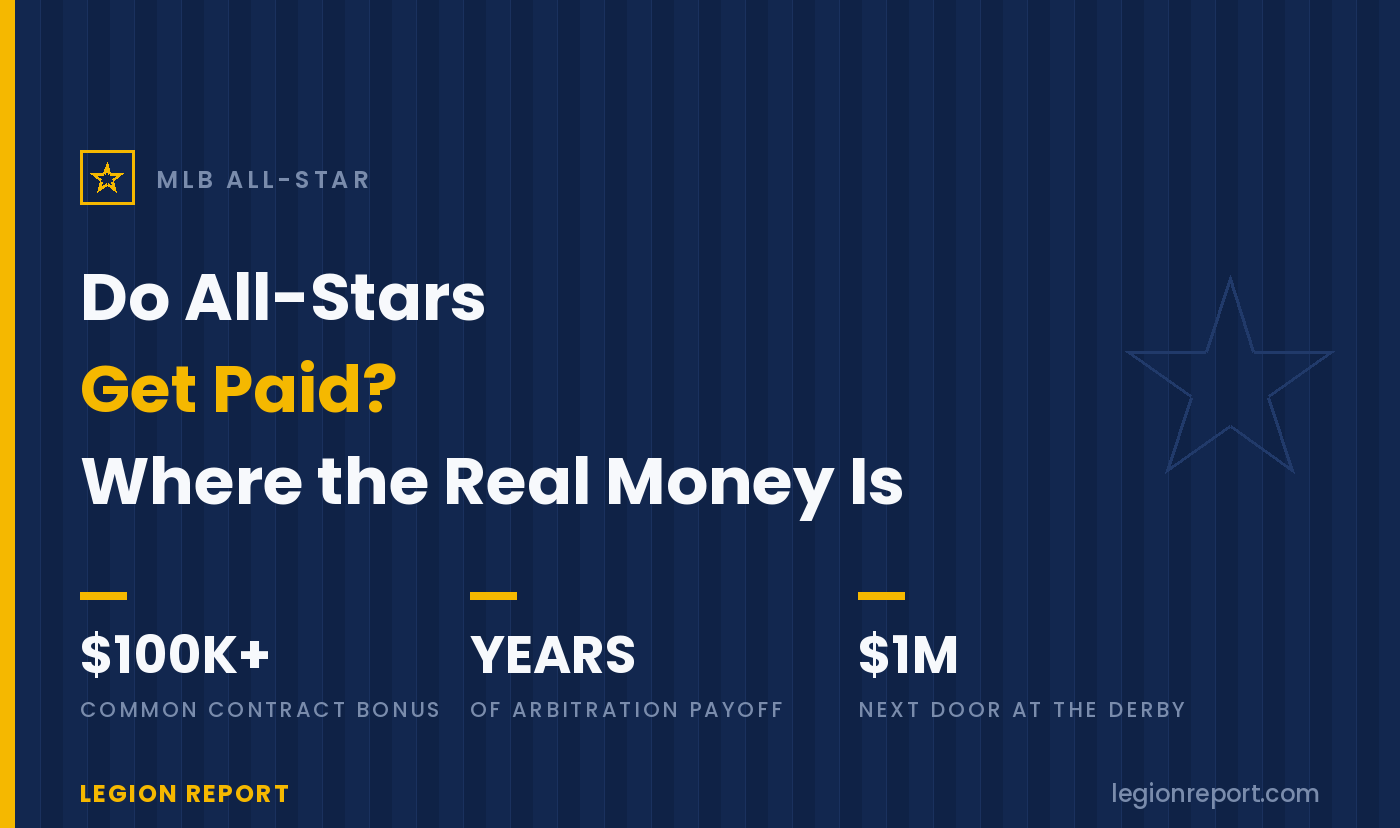

Do MLB players get paid extra for making the All-Star team? The league’s own check is famously modest — but the honest answer is that an All-Star selection is worth serious money anyway, just through side doors: contract bonuses that pay six figures the moment the roster is announced, arbitration leverage that compounds for years, and a week of gifts, expenses, and exposure. Here’s where the real All-Star money actually lives.
The chart below covers the direct pay, the incentive clauses, and the hidden compounding value. Take a look, then we’ll break it all down.
The Payday Is the Press Release
All-Star compensation is baseball’s clearest example of an honor being worth more than a check. The league’s direct payment has always been beside the point; the machinery around the selection is where the money moves. For established veterans, the All-Star bonus clause is boilerplate — negotiated years earlier, commonly in the $50,000-to-$100,000 range and sometimes far higher, triggered the instant the roster drops, which means the actual payday happens at a press release, not a ballgame. For pre-arbitration and arbitration-era players the math is bigger and slower: arbitration panels and comparable-player models treat All-Star selections as hard résumé currency, so a single July nod can echo through three winters of salary figures — the reason agents fight snub battles that fans find silly. Layer on the week itself (family travel covered, the famous gift haul, the Derby’s $2.5 million pool one night earlier, sponsor activations for anyone marketable) and the answer resolves cleanly: no, All-Stars aren’t paid much *for the game* — and yes, making the team is one of the most financially consequential things a young player can do. It also explains the modern participation puzzle: once the selection triggers the bonus, playing the game adds injury risk and zero dollars, which is why a banged-up star’s “rest” decision is often just contract logic wearing a compression sleeve.
Final Word
Do MLB All-Stars get paid? The league’s check is modest — the money is in contract bonus clauses ($50K-$100K+ paid at selection), years of arbitration leverage, covered expenses and gifts, and the week’s side earnings, headlined by the Derby’s $1M winner’s check one night earlier. The selection is the payday; the game is the party. Tuesday’s edition is in Philadelphia.
The night that DOES cut a giant check is in Home Run Derby prize money, how the rosters get chosen is in MLB All-Star voting, explained, and whether the game’s stats count is in does the All-Star Game count?.