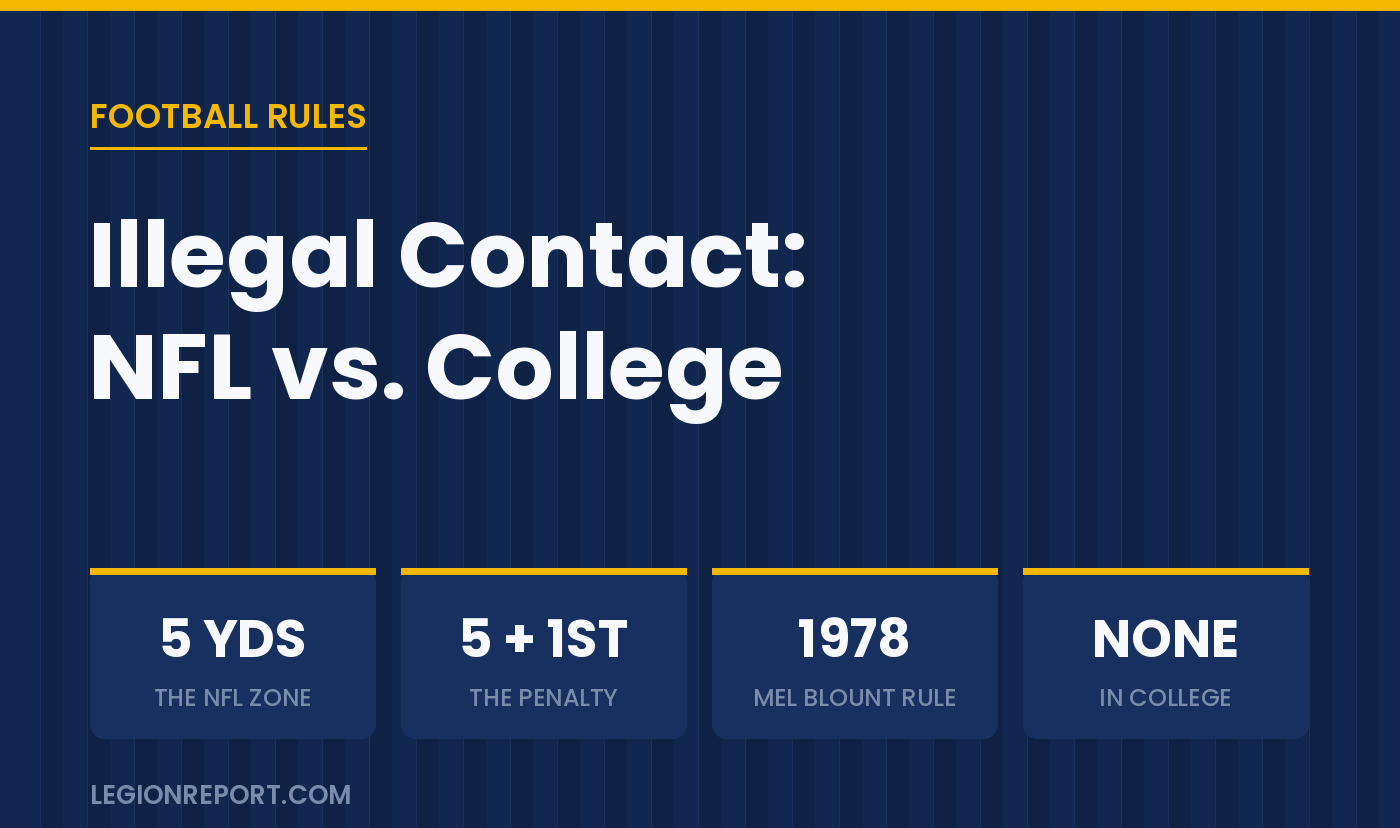
Illegal contact is the NFL’s five-yard fence — the rule that says a defender may jam a receiver freely within five yards of the line of scrimmage, and may not initiate contact with him beyond it while the quarterback is in the pocket with the ball. It costs five yards and an automatic first down, and it is the rule most responsible for the modern passing game: without it, physical corners could reroute receivers all the way down the field, as they did before 1978 and still can on Saturdays.
That’s the headline difference between the levels: college football has no illegal contact rule. An NCAA defender can legally contact a receiver anywhere downfield until the ball is in the air, as long as the contact isn’t holding and doesn’t become interference once the pass is thrown. It’s why college defenses can play aggressive match coverage that would draw flags every snap in the NFL — and why physical college corners face an adjustment curve as rookies.
The chart below covers the rule’s conditions, the college contrast, and how it interacts with holding and PI. Take a look, then we’ll get into the rule’s history — it exists because of one team.
FOOTBALL RULES
Illegal Contact: NFL vs. College Football
The five-yard rule that built the modern passing game
THE ZONE
5 yards
Contact legal inside
PENALTY
5 + 1st
Automatic first down
CONDITION
QB in pocket
Ball not thrown
COLLEGE
No rule
Contact legal to the throw
The rule’s conditions
When contact is and isn’t legal
| Condition | NFL rule |
|---|
| The zone | Contact is legal within 5 yards of the line of scrimmage — the jam, the reroute, the chuck |
| Beyond 5 yards | A defender may not initiate contact with a receiver who is attempting to run his route |
| QB condition | The restriction applies only while the QB is in the pocket with the ball; once he leaves the pocket or the ball is thrown, downfield contact rules relax |
| The penalty | 5 yards and an automatic first down |
| Incidental contact | Legal — a defender running his own path who makes unavoidable contact isn’t flagged; the foul requires initiating |
| After the ball is thrown | Contact fouls become pass interference, judged separately |
NFL vs. college
The biggest coverage difference between levels
| NFL | College (NCAA) |
|---|
| Contact window | 5 yards | Unlimited until the ball is in the air |
| Downfield contact before the throw | Illegal contact — 5 + automatic first | Legal unless it’s holding (grabbing/restricting) |
| Effect on coverage | Press must win early; corners play with restraint downfield | Match and press coverage stay physical the whole route |
| Effect on offenses | Timing routes and free releases thrive | Receivers must fight through contact deep into routes |
| Draft implication | Physical college corners must retrain hands; smooth NFL route-runners feast on the space | |
Scenarios
How the conditions interact
| Scenario | Ruling (NFL) |
|---|
| Jam at 3 yards, receiver rerouted | Legal |
| Hand-check at 8 yards, QB in pocket | Illegal contact |
| Contact at 8 yards after QB scrambles from pocket | Legal — the pocket condition lifted |
| Contact at 8 yards, ball already in the air | Judged as PI or nothing — illegal contact no longer applies |
| Grab (not just contact) at 8 yards | Defensive holding, not illegal contact |
| Receiver initiates the contact | No foul on the defender; offensive PI possible if it’s a push-off later |
ILLEGAL CONTACT FACTS
The Mel Blount rule
The 1978 restriction was written to stop Pittsburgh’s Blount from mauling receivers all over the field — it’s the rule most credited with unleashing the passing era.
2004 re-emphasis
After the Patriots manhandled the Colts’ receivers in the 2003 AFC title game, the league ordered strict enforcement — passing numbers jumped immediately, proving the flag rate is a dial.
The pocket clause is the loophole
Once the QB scrambles, downfield contact restrictions lift — one reason defenses love moving quarterbacks off the spot even without a sack.
The NFL’s five-yard illegal contact rule and why college has no equivalent.
The Rule That Made the Modern NFL
Before 1978, defenders could legally bump, ride, and reroute receivers anywhere on the field, and passing offenses looked like it — league-wide completion rates sat in the low 50s. The illegal contact rule (with the same year’s blocking liberalizations) is the single biggest reason the NFL became a passing league, and every subsequent enforcement ‘point of emphasis’ has been the league turning the same dial: more flags, more passing, more points. College football’s refusal to adopt the rule is equally deliberate — it preserves defensive physicality and keeps the two versions of the sport meaningfully different, which is exactly what scouts wrestle with every spring.
The Bottom Line
Illegal contact bars NFL defenders from initiating contact with receivers more than five yards downfield while the quarterback holds the ball in the pocket — five yards and an automatic first when they do. College has no such rule, allowing contact until the ball is in the air, which is the sharpest coverage difference between the levels. For the grab version of the foul, see defensive holding, and for what the same contact becomes once the pass is thrown, pass interference explained.