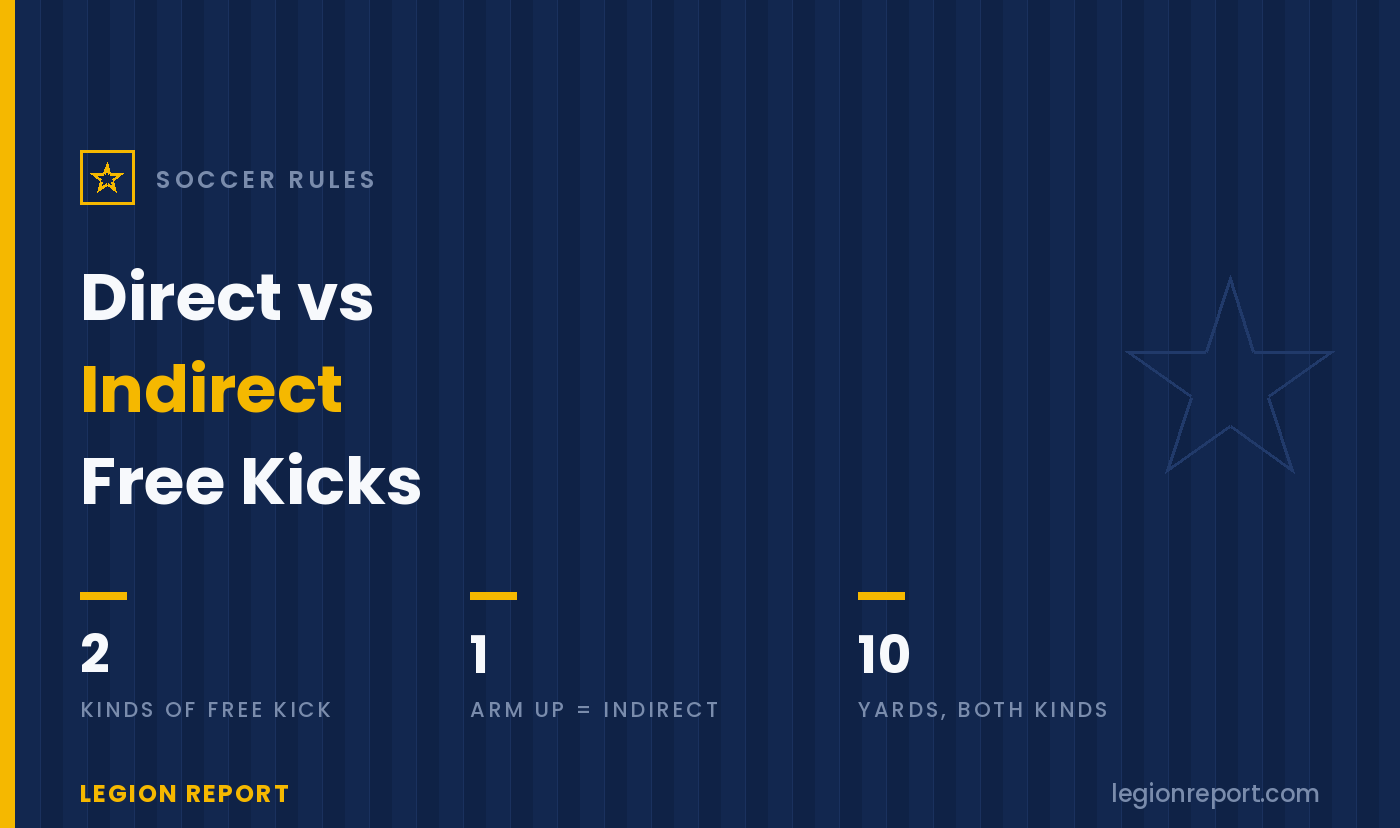

Every free kick in soccer is one of two species, and the difference decides everything that happens next. A direct free kick can be struck straight into the goal, one touch, net, celebrate. An indirect free kick cannot: the ball must touch another player, from either team, before it crosses the line, or the “goal” doesn’t count. Same whistle, same spot, same wall, completely different weapon.
The split isn’t random. Direct free kicks punish physical crimes, the kicks, trips, holds, and handballs. Indirect free kicks punish technical ones, offside, dangerous play, the goalkeeper’s paperwork violations. And the rulebook wraps the whole thing in details most fans never learn: the referee announces an indirect kick with a raised arm held aloft until the second touch, an indirect kick blasted straight in becomes a goal kick, and an indirect offense inside the box produces soccer’s strangest set piece, a free kick from six yards with the entire defense legally camped on its own goal line.
The chart below sorts it all: the one-line difference, the complete offense lists for each kick, the outcome matrix for every scenario, and how to read the referee in real time. Take a look, then we’ll break it all down.
The split, and why it exists
Soccer’s lawmakers built two free kicks because offenses come in two moral categories. Physical wrongdoing, kicking, tripping, charging, pushing, holding, striking, reckless tackles, plus handball, earns the direct free kick: full weaponized possession, scoreable with a single touch, and upgraded to a penalty kick when it happens inside the offender’s own box. Technical wrongdoing, offside, dangerous play without contact, impeding, dissent, and the goalkeeper’s administrative sins like handling a deliberate back-pass, earns the indirect free kick, a restart deliberately defanged: the ball must touch a second player before a goal can count. The referee broadcasts which one you’re watching with his arm, pointed forward for direct, held straight overhead for indirect and kept there until the required second touch happens.
The outcomes most fans get wrong
The matrix produces some counterintuitive results worth memorizing. An indirect kick blasted straight into the net is not a goal, play restarts with a goal kick, but the faintest touch from anyone legalizes it, including a defender in the wall, which is why takers of close-range indirect kicks often simply shoot and hope for a graze. A free kick of either type sent directly into the kicker’s own goal is never an own goal; it’s a corner to the opponents. And the geography rule cuts both ways: a direct offense in the box becomes a penalty, while an indirect offense in the box stays an indirect kick taken from the spot of the crime, producing the sport’s rarest spectacle, an attack from six or eight yards against ten defenders legally stationed on their own goal line. It’s the closest soccer comes to a hockey power play, and it almost always ends in a blocked shot and chaos.
Why the distinction matters tactically
For the defending team, the two kicks demand different walls: a direct kick 22 yards out is a genuine shooting threat requiring the full wall-and-draft-excluder apparatus, while an indirect kick from the same spot is really a pass waiting to happen, so the defense marks runners instead of bracing for the strike. For attackers, the indirect kick’s second-touch requirement created its own micro-play: the one-inch tap. One player nudges the ball, satisfying the touch requirement, and a teammate hammers the now-live ball at goal. Get the sequence wrong, striking an untouched indirect kick into the net, and a lifetime highlight becomes a goal kick and a lesson.
Final Word
Direct vs. indirect free kicks, settled: direct kicks punish physical fouls and handball, can be scored with one touch, and become penalties in the box; indirect kicks punish technical offenses, need a second touch from anyone before a goal counts, and are announced by the referee’s raised arm. Straight-in outcomes differ (goal vs. goal kick), own-goal outcomes don’t (corner either way), and the in-box indirect kick remains the strangest sight in the sport. Two kicks, one whistle, and now you’ll never wonder why the referee is holding his arm up.
This is the deep-dive companion to our full free kick guide, which covers the wall rules and the greatest strikes. The restart next door is the corner kick, and the offense that produces the most famous direct kicks of all lives in DOGSO explained.